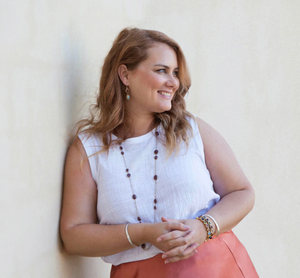
Understanding Yourself After an ADHD Diagnosis: Bindi's Story
In our last article ‘You just received an ADHD diagnosis- now what?’, we explored the chapter that can get missed after discovering you’re neurodivergent.
The part where you have a diagnosis, perhaps some new information about how your brain works, but a whole lot of questions about what it actually means for your life.
Today, I’d love to hand the microphone over to our brilliant AuDHD therapist, Bindi Forrester, who has generously shared some of her own experience.
And as you’ll discover, even someone who now works professionally in this space can have a rather complicated relationship with their own diagnosis.

In Bindi’s words…
When I was diagnosed with ADHD, I remember feeling a mix of relief and uncertainty. I saw my psychiatrist, got the diagnosis, was prescribed stimulant medication, and that was essentially it.
What I didn’t get was much space to actually understand my life through a neurodivergent lens.
No real exploration of the patterns I’d developed, the strengths I’d built, the things I found difficult, or what it meant to have spent years navigating the world without knowing I was neurodivergent (and the stories I’d internalised about myself because of it).
And particularly as a woman, so much of my experience didn’t fit the stereotypical picture of neurodivergence I’d grown up with.
Additionally, there was no mention of the fact that my neurodivergence could actually be positive in many ways (no one can scan the house like me on a hyperfixation!).
I think that’s partly why, for a while, I genuinely thought I’d somehow scammed my psychiatrist.
That I wasn’t really neurodivergent, just lazy, impulsive, really into trinkets (and whatever unkind word I could find for myself that week).
It wasn’t until I started properly learning about ADHD, AuDHD, autism, and the neuroaffirming understanding of neurodivergence that I began to recognise myself so clearly in what I was reading.
Suddenly, all these seemingly unrelated parts of my life started to make sense together.
(I have more highlighted book pages and “THIS IS SO ME” texts to my older sister than I can count.)
That’s when the diagnosis actually became useful.
Not the label or the prescription on their own, but having a framework to understand myself, and from there, starting to work out what I actually needed.
There’s grief in that process too.
Looking back and wondering what might have been different if I’d understood myself sooner.
Uncertainty about what it means for the future (how do I support myself, knowing my capacity isn’t the same as someone who’s allistic or neurotypical?).
But over time, I’ve moved away from asking “How do I make myself function like everyone else?” and towards asking “What do I actually need to function well?”
These days, being neurodivergent is much more about honouring my sensory needs, understanding my capacity, and working with my executive functioning instead of constantly fighting it.
And when I’m right in the middle of an AuDHD moment and things aren’t going to plan, having that understanding gives me a bit more compassion for myself, and permission to do what I actually need.
That’s part of what I value about neuroaffirming therapy.
A diagnosis names your experience, but it doesn’t tell you what to do with that knowledge.
Therapy is where you get the space to make sense of your own neurodivergent profile. Your strengths, your challenges, the adaptations you’ve built, and the parts of yourself you’ve maybe spent years trying to hide or override.
Working with a neurodivergent therapist can mean you spend less energy explaining why something that looks simple from the outside is actually complex from the inside.
Sometimes it’s bigger things.
Sometimes it’s just feeling comfortable enough to fidget, ask for the lights to be dimmed, or go on a neurodivergent tangent without having to justify it.
A little note from Gabriella
What I love about Bindi’s story is that it reminds us how much more there is to understanding ourselves than receiving a label.
It’s about recognising what we’ve been carrying, questioning the expectations we’ve absorbed, and discovering that perhaps we don’t need to keep fighting ourselves quite so hard.
And it’s one of the reasons I’m so pleased to have Bindi on our team.
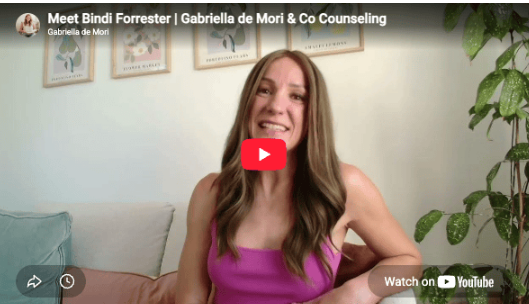
If her story resonated with you, perhaps you’d like to meet the woman behind the words.
We’ve put together a short welcome video where Bindi introduces herself and shares a little about what it’s like to work with her.
If you'd like some support exploring these questions, this is where our neuroaffirming counselling comes in.
Our approach isn’t about trying to “fix” your brain. It’s about understanding how your mind works, recognising the strengths and adaptations you’ve developed, and exploring practical strategies and environments that genuinely support you.
Keeping it spicy,
Gabriella de Mori Founder & Director Registered Clinical Counsellor Gabriella de Mori & Co Counselling
Ps. In bonus news, Bindi has 3 appointments available next week! To enquire, simply complete the form on Bindi's page here.
Double-click to edit...